Indeed’s Employer Assist
The Concept That Made a Big Dent in Indeed's #1 Problem
Job seekers apply and never hear back. Employers get flooded with applications and go silent. "Professional ghosting" was identified by Indeed's senior leadership as the company's top priority in 2019 – and a concept I pitched in a workshop became one of the most effective responses to it.

The problem
Both sides of the hiring conversation were broken
Getting no response from an employer was the single biggest detractor for job seekers on Indeed. And for employers, the inverse was equally true – flooded with applications, many simply did nothing rather than send uncomfortable rejection messages. The result was a marketplace full of unanswered conversations and frustrated users on both sides.
Indeed had tried small fixes before. They hadn't worked. This time, senior leadership flagged the problem as a company-wide priority, and a cross-functional team was organized to take a serious run at it – bringing together designers and researchers who would normally sit in separate product silos, because a two-sided communication problem needed a two-sided solution.
Solving this required working across Indeed's typical org boundaries. A design manager trusted the team and championed the cross-functional approach. Without that support, the project couldn't have been structured the way it was.

My role
Concept originator and design lead throughout
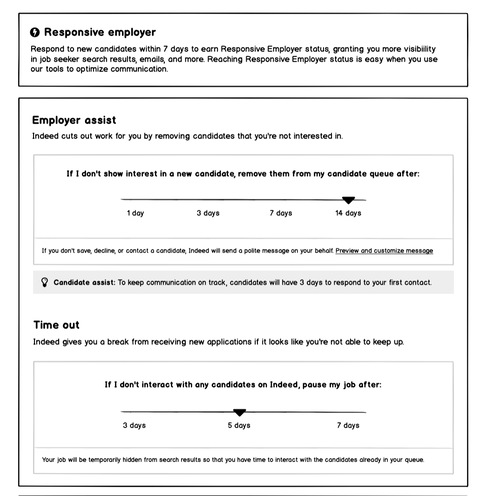
The core concept, Employer Assist, came to me during the initial workshop and I pitched it to the group: an explicit agreement between Indeed and the employer that they would respond to new applications within a time frame of their choosing. If they didn't act, Indeed would step in. The idea gave employers a sense of control while creating the accountability the marketplace needed.
From that starting point, I drove the design end-to-end. During the sprint, I worked alongside another designer and our researcher to rapidly iterate and test. When the sprint concluded, I continued as the sole designer through the full build, involved in research, design reviews, legal reviews, and team presentation.
The PM owned the legal team relationship directly, and we collaborated closely on how to respond to their concerns, which were significant given that the feature would automatically decline candidates on employers' behalf. My job was to ensure the design communicated clearly enough to earn user trust and withstand that scrutiny.
Who did what:
Me: concept originator, design lead from sprint through launch, UX and visual design, copywriting
Fellow designer: collaborative partner during the 4-week sprint
UX researcher: led research sessions, guided iteration pace and direction
PM: cross-functional alignment, legal liaison, scope definition
The solution
An agreement, not a feature
The insight behind Employer Assist was that the problem wasn't a UI problem, it was a behavioral one. Employers didn't respond because there was no expectation that they would. The solution was to create one.
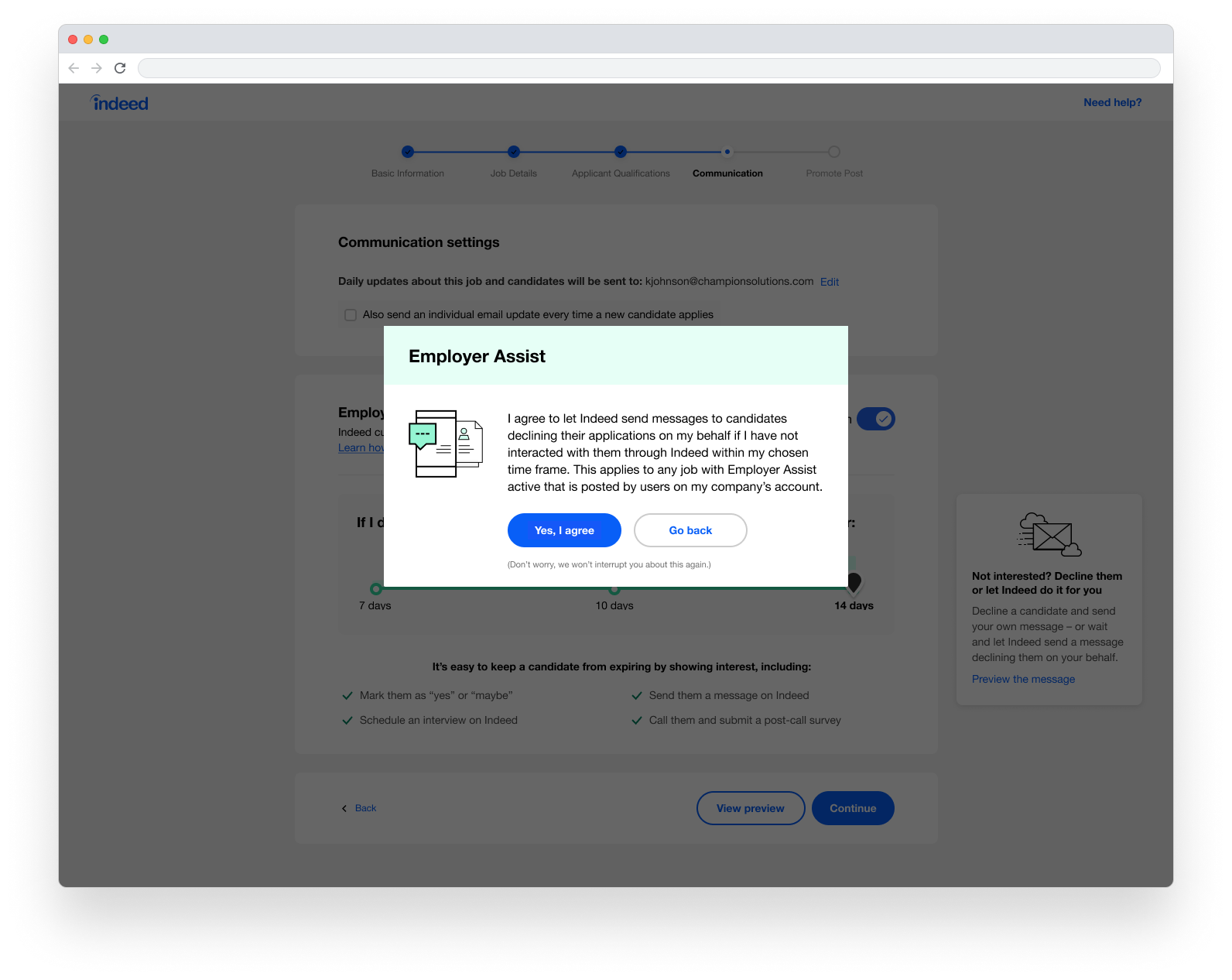
When posting a new job, employers make an explicit agreement with Indeed: they'll respond to new applications within a time frame of their choosing. If they don't act on an application, Indeed assumes they're not interested, automatically declines the candidate, and removes them from the active queue. Employers stay in control; the marketplace stays honest.
The longer-term vision, Indeed Assist, extends the same logic to candidates: an agreement to stay active in their applications, with Indeed stepping in automatically if they go quiet. The v1 focus was on the employer side, with the candidate side to follow once we'd proven the model.


Process
Sprint Fast, Then Go Deep
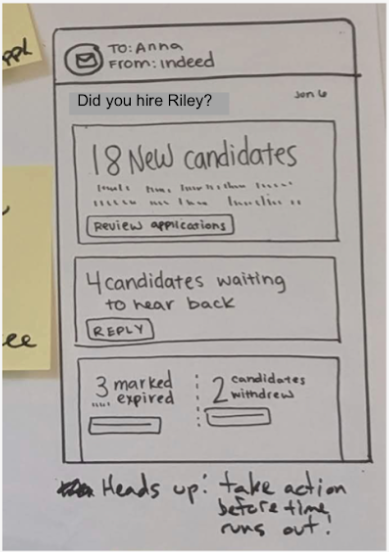
The project kicked off as part of a 3-day workshop: research, interviews with real employers and job seekers, and the session where the Employer Assist concept emerged. When the concept showed promise, that went directly into a 4-week design sprint: rapid low-fidelity iterations tested with 28 real users, guided by our researcher, refined continuously based on what we heard.
The speed of the sprint was deliberate. Getting real user reactions early before committing to high fidelity let us pressure-test the core concept and surface the edge cases that would matter most to legal: what happens when a candidate is auto-declined unfairly? How do we communicate the stakes clearly enough that no one is surprised?
Once the sprint concluded and scope was defined with product and engineering, I moved the designs to full fidelity using Indeed’s design system and stayed tightly involved through the build – reviewing implementations, refining copy, and making sure the experience held up under the constraints of a live product.
Navigating Risk
Designing around legal scrutiny
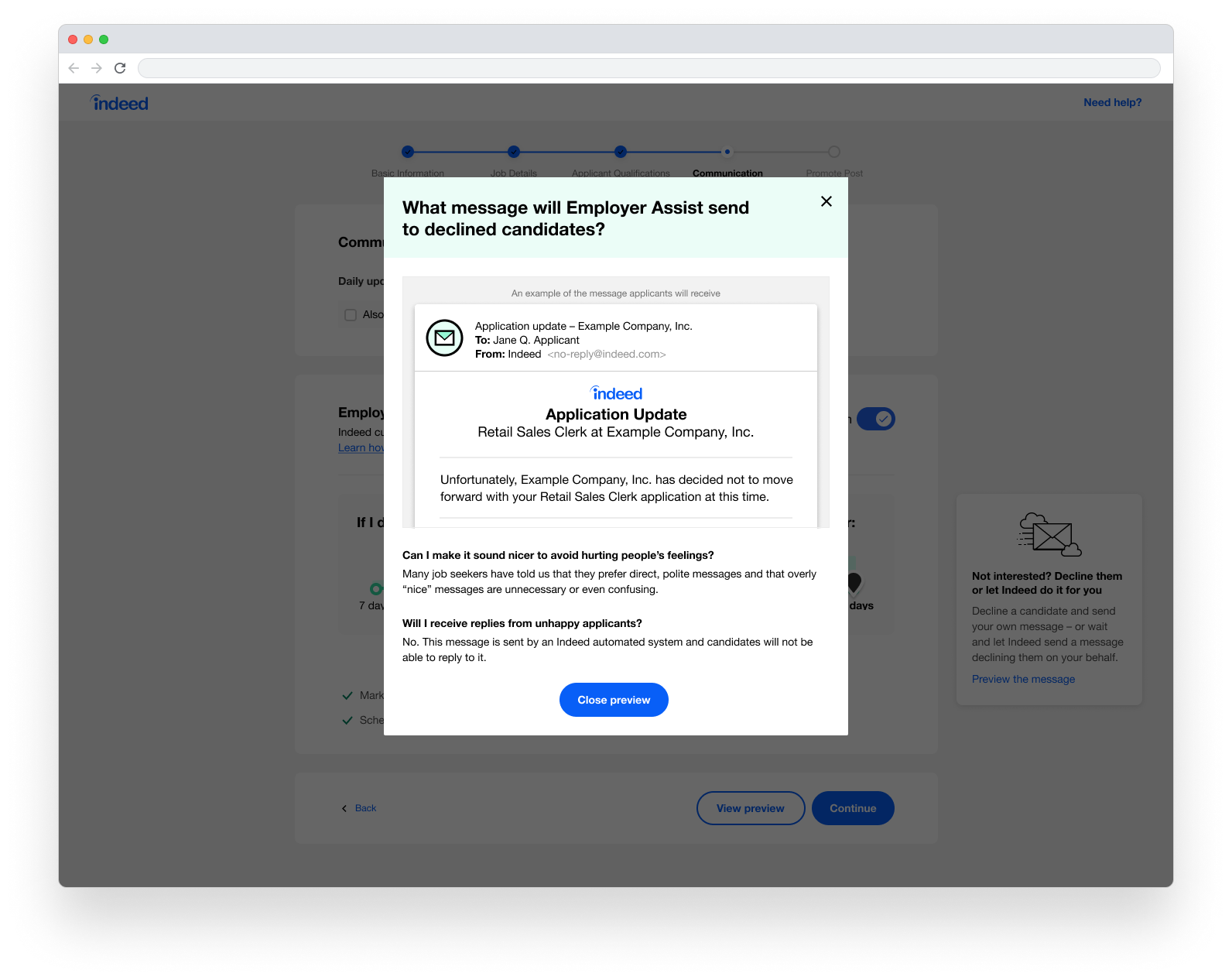
Automatically declining candidates and affecting people's job prospects put Employer Assist under significant legal review from the start. The PM owned that relationship directly, but the design was at the center of every conversation: did the messaging give employers enough warning? Were candidates informed clearly enough about what was happening and why?
My response was to treat communication design as a risk mitigation strategy. Every touchpoint – on-site messaging, countdown warnings, automated emails – was written and designed to create shared understanding between Indeed, employers, and candidates before any automatic action was taken. The goal was a system where no one could reasonably claim they weren't informed.


Impact
Results that exceeded every benchmark
The goal was a 10% improvement in employer response rates. The results were substantially better — a meaningful impact on a problem the company had been trying to crack for years.
Employer Assist was ramped to 100% of US users and expanded internationally. Candidate Assist, the other side of the original vision, subsequently entered development.